Trending

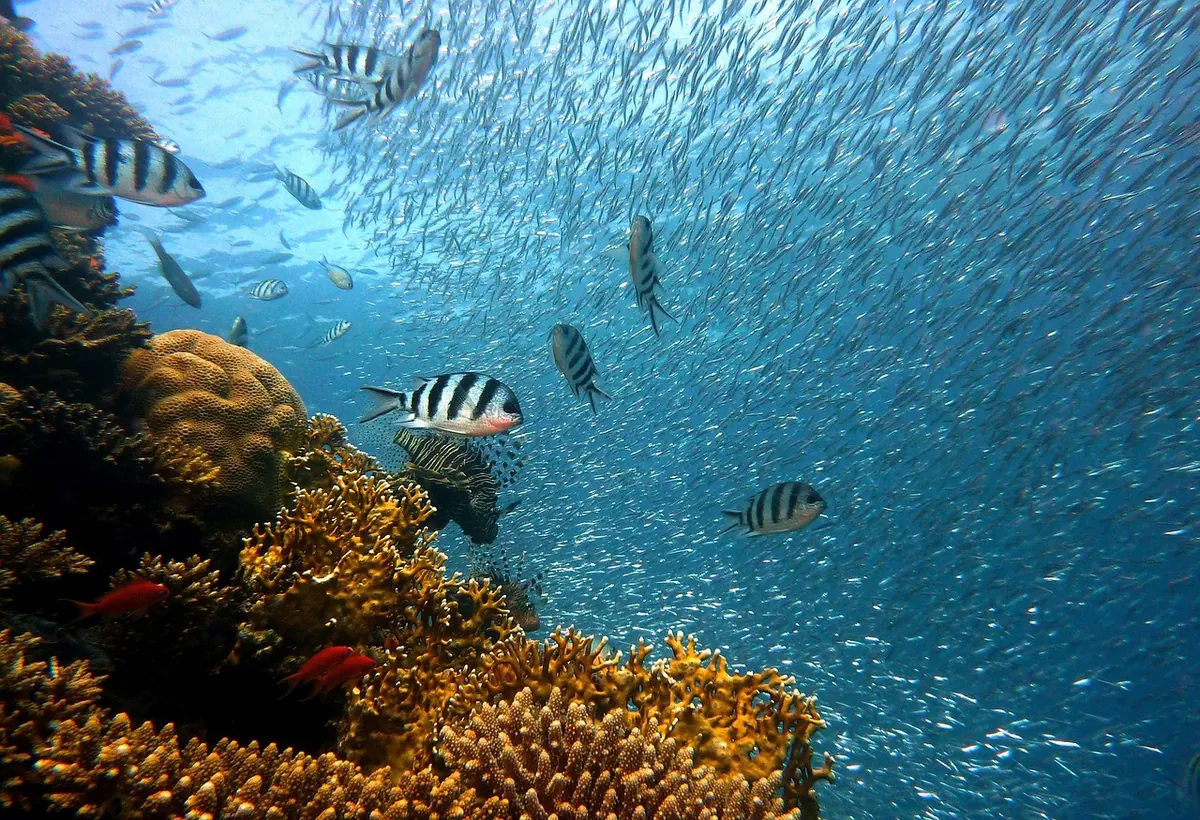
Most coral you meet — on a reef, in a tank, or in a shoebox of holiday finds — is easiest to identify once the polyps have retreated. Colour fades, tentacles vanish, but the skeleton keeps its shape. Learn three genera properly and you will start reading hard corals the way birdwatchers read silhouettes: Acropora with its built-in leading tip, Euphyllia with its outsized toothy corallites, and Montipora with tiny pores wrapped in a heavily textured surface. Everything here can be seen with a 10x hand lens and a bit of raking light.
Step back before you lean in. Colony shape narrows the field faster than any single corallite. Encrusting, plating, branching, digitate, table, massive, meandroid — each form points towards a handful of genera and away from the rest.
Treat shape as a hint, not a verdict. The same species can plate in deeper, calmer water and branch in shallow surge; light and current bend growth constantly. A fragment narrows things down, but it will rarely settle a species on its own.
Ask three questions at colony level before you reach for the lens: Is the surface flat, domed, or branched? Are the branches thick and antler-like, or thin and pencil-straight? Do corallites cover every side, or are they concentrated on one face? The answers tell you where to look next and how much magnification you will need.
One feature settles this genus almost every time: the axial corallite. At the end of each branch sits a single, larger corallite — a short tube or cone with its own opening, standing proud of everything around it. Underwater, look for the pale cluster of tips at the end of each branch; on a dry skeleton, that row of nubs is easy to see in silhouette. No other common reef-building genus does this.
Everything else on the branch is a radial corallite, and their shapes are the language of species identification.
The surface between them — the coenosteum — is porous, often finely spiny or reticulate, giving a pitted honeycomb look under a lens. Branches are usually round in cross-section and taper cleanly to the tip. Growth forms worth knowing by name: staghorn, table, corymbose (short branches in neat clusters), digitate (finger-like), bottlebrush, bushy and encrusting. A single colony can show two forms at once, so check several branches before you commit.
Examples help fix the pattern. Acropora cervicornis, the classic staghorn, has thick, antler-like branches with obvious axial corallites. Acropora hyacinthus spreads into tables with fine, tightly packed branches. Acropora millepora often grows corymbose, with crowded radial corallites that sit mostly flush. In all of them, the axial tip is the anchor. If every branch ends in a larger, open corallite, you are almost certainly looking at Acropora.
Euphyllia skeletons are big and open. Corallites are typically a centimetre or more across, with thin walls and septa that rise steeply towards the centre. Those septa carry tall, blade-like teeth that look like fins when you sight along a corallite from the side. Broad diameter, thin wall, prominent teeth: that combination is the giveaway.
Two skeletal arrangements turn up in this group:
A caution on names. Recent genetic work has reshuffled this group, and several familiar species have moved into sibling genera such as Fimbriaphyllia. Skeleton alone will get you confidently to the group; species-level calls belong to people with a microscope and the current literature.
For example, torch corals typically show long, tubular phaceloid corallites, while frogspawn-type skeletons tend towards broader, fused valleys. Even when the polyps are gone, that difference in corallite arrangement is often enough to separate the two habits. Look at the base, not just the crown: separate tubes or continuous ribbons?
Montipora is the quiet one. Its corallites are small — often under a millimetre across — and usually sit flush with the surface or barely raised, without the neat crater wall you see in Porites. What makes the skeleton distinctive is everything between the corallites. The coenosteum is crowded with papillae (fine bumps), verrucae (larger nodules), ridges and tubercles, so a cleaned plate feels rough and looks frosted rather than smooth.
Growth forms include encrusting, plating, foliaceous and branching; Montipora digitata, with its finger branches and raised nodules, is a familiar example. Because the skeleton is small and textural, identification leans on the overall pattern rather than one dramatic corallite. Run a fingertip across a dried plate: if it feels like fine sandpaper and the surface sparkles with tiny bumps under raking light, Montipora is a strong candidate. Compare that with Porites, whose small corallites sit in a smoother, more honeycomb-like surface without the crowded papillae.
Use this order when a skeleton is in front of you:
Identify the skeleton first, then let colour and polyps confirm it.
In shorthand: Acropora has an axial tip and varied radial corallites; Euphyllia has broad, toothy corallites in phaceloid or meandroid arrangements; Montipora has tiny flush corallites set in a rough, papillate coenosteum.
You do not need harsh chemicals to read a skeleton. Rinse away loose sand and organic film with fresh water, then soak in dilute bleach — roughly one part household bleach to ten parts water — until tissue and algae lift. Rinse thoroughly and dry in shade. Never bleach live coral or protected reef material; work only with legally obtained dead skeletons or aquarium frags.
Light matters more than magnification. Use a single desk lamp or phone torch from the side, almost parallel to the surface. Raking light throws corallite rims, septal teeth and papillae into relief, turning a flat plate into a readable landscape. A 10x hand lens or a cheap macro clip-on lens is enough. For photographs, place the skeleton on dark cloth, light from the side, and include a coin or ruler for scale.
Finally, practise on three confirmed specimens: one Acropora, one Euphyllia, one Montipora. Sketch each one, label the axial corallite, septal teeth or papillae, and write down the colony form. After that, unidentified fragments become far less mysterious. You will not know every species, but you will recognise the three big silhouettes — and that is the skill that makes hard coral identification genuinely useful.
Photo: joakant / Pixabay